
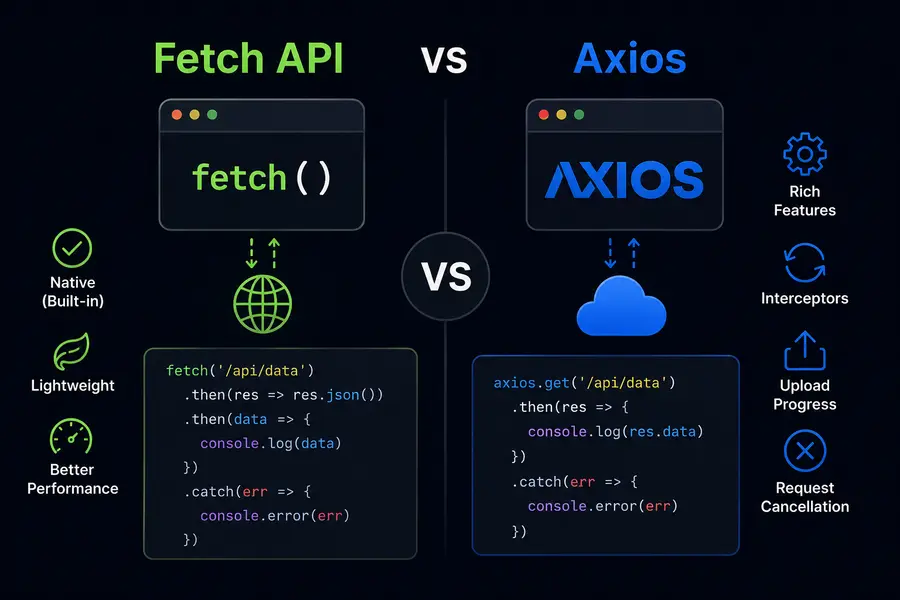
Fetch API vs Axios: Which Is Better for Network Requests?
Network requests are the foundation of modern web applications.
Whether you are fetching blog posts, submitting forms, or communicating with external APIs, applications need a reliable HTTP client.
For years, Axios became the default solution for handling API requests in JavaScript applications.
However, modern browsers and Node.js now provide the native Fetch API, raising an important question:
Do developers still need Axios?
What Is Fetch API?
Fetch API is the modern built-in JavaScript interface for performing HTTP requests.
Because Fetch is native, developers do not need additional packages.
- No npm installation
- No extra bundle size
- Built directly into browsers
- Supported in modern Node.js
Basic Fetch Example
fetch('/api/users')

    .then(response => {

        if (!response.ok) {

            throw new Error(
                'Request failed'
            );
        }

        return response.json();
    })

    .then(data => {

        console.log(data);
    })

    .catch(error => {

        console.error(error);
    });
Fetch uses Promises and supports modern async workflows naturally.
Common Fetch Limitations
Despite being powerful, Fetch requires more manual work compared to Axios.
- Manual JSON parsing
- Manual HTTP error handling
- More verbose syntax
Developers must manually check response.ok because Fetch does not reject promises for HTTP errors like 404 or 500.
What Is Axios?
Axios is a popular third-party HTTP client library for JavaScript and Node.js.
It simplifies many common networking tasks automatically.
npm install axios
Basic Axios Example
import axios from 'axios';

axios.get('/api/users')

    .then(response => {

        console.log(
            response.data
        );
    })

    .catch(error => {

        console.error(error);
    });
Axios automatically parses JSON responses and throws errors for failed HTTP status codes.
Why Axios Became Popular
- Cleaner syntax
- Automatic JSON parsing
- Built-in error handling
- Interceptors support
- Upload progress tracking
- Request cancellation
Fetch vs Axios Error Handling
Fetch Behavior
const response =
    await fetch('/api/users');

if (!response.ok) {

    throw new Error(
        'Request failed'
    );
}
Fetch only rejects promises for network failures.
Axios Behavior
try {

    const response =
        await axios.get(
            '/api/users'
        );

} catch (error) {

    console.error(error);
}
Axios automatically rejects failed HTTP responses like 404 and 500.
Automatic JSON Handling
Fetch requires an extra parsing step.
const response =
    await fetch('/api/users');

const data =
    await response.json();
Axios returns parsed JSON directly.
const response =
    await axios.get(
        '/api/users'
    );

console.log(
    response.data
);
Interceptors
Interceptors are one of Axios’s most powerful features.
They allow developers to modify requests and responses globally.
axios.interceptors.request.use(
    config => {

        const token =
            localStorage.getItem(
                'token'
            );

        if (token) {

            config.headers.Authorization =
                `Bearer ${token}`;
        }

        return config;
    }
);
This is extremely useful for JWT authentication systems.
Request Cancellation
Modern Fetch uses AbortController for request cancellation.
const controller =
    new AbortController();

fetch('/api/users', {
    signal: controller.signal
});

controller.abort();
Axios also supports AbortController in modern versions.
Upload Progress
Axios makes file upload progress tracking significantly easier.
axios.post('/upload', file, {

    onUploadProgress:
        progressEvent => {

            console.log(
                progressEvent.loaded
            );
        }
});
Implementing this manually with Fetch is more complicated.
Bundle Size
- Fetch → Native and zero-size
- Axios → Additional dependency
For highly optimized frontend bundles, Fetch has the advantage.
When to Use Fetch
- Small projects
- Simple API requests
- Performance-focused applications
- Frameworks with built-in wrappers
- Minimal dependencies
When to Use Axios
- Large applications
- JWT authentication systems
- Global request handling
- File uploads
- Complex API workflows
Modern Framework Trends
Modern frameworks like Next.js increasingly rely on native Fetch wrappers instead of Axios.
This trend pushes developers closer to the platform itself.
Conclusion
Fetch API represents the modern native standard for HTTP requests in JavaScript.
Axios remains an excellent developer-focused abstraction that simplifies many complex networking workflows.
For simple applications, Fetch is often enough.
For large-scale applications with authentication, interceptors, and advanced request management, Axios still provides one of the best developer experiences available.