
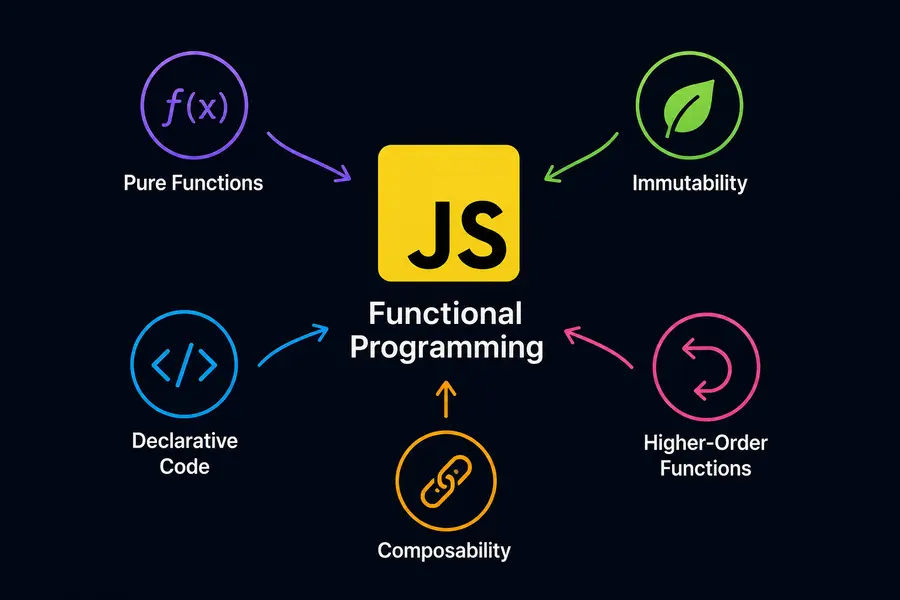
Functional Programming in JavaScript: Write Cleaner and Safer Code
Most JavaScript developers begin programming using the imperative style without even realizing it.
We manually control loops, mutate arrays, update objects directly, and manage application state step by step.
Functional Programming introduces a different mindset focused on predictability, immutability, and declarative logic.
Modern frameworks like React heavily rely on Functional Programming concepts internally.
Imperative vs Declarative Programming
Imperative Style
Imperative code explains how operations should execute step by step.
const numbers = [1, 2, 3, 4];

function doubleNumbers(arr) {

    let result = [];

    for (
        let i = 0;
        i < arr.length;
        i++
    ) {

        result.push(
            arr[i] * 2
        );
    }

    return result;
}
The developer manually controls loops and state mutations.
Declarative Style
Declarative programming focuses on what should happen instead of how to execute it.
const numbers = [1, 2, 3, 4];

const doubled =
    numbers.map(
        num => num * 2
    );
The implementation details are abstracted away.
Pure Functions
Pure Functions are one of the most important principles of Functional Programming.
A Pure Function follows two rules:
- Same input always produces the same output
- No side effects
Impure Function
let taxRate = 0.1;

function calculate(price) {

    taxRate += 0.01;

    return price * taxRate;
}
This function mutates external state and becomes unpredictable.
Pure Function
function calculate(
    price,
    taxRate
) {

    return price * taxRate;
}
The function becomes predictable and easier to test.
Immutability
Immutability means avoiding direct mutations and instead creating new copies of data.
Mutable Approach
const user = {
    name: 'Alice',
    age: 30
};

user.age = 31;
The original object changes permanently.
Immutable Approach
const user = {
    name: 'Alice',
    age: 30
};

const updatedUser = {
    ...user,
    age: 31
};
The original object remains unchanged.
Why Immutability Matters in React
React relies heavily on immutable state updates.
React compares references in memory to determine when components should re-render.
Mutating objects directly can prevent React from detecting state changes correctly.
Higher-Order Functions
Higher-Order Functions either:
- Receive functions as arguments
- Return functions
JavaScript array methods are classic examples.
map()
const doubled =
    numbers.map(
        num => num * 2
    );
filter()
const evens =
    numbers.filter(
        num => num % 2 === 0
    );
reduce()
const total =
    numbers.reduce(
        (acc, num) => acc + num,
        0
    );
Benefits of Functional Programming
- Cleaner code
- Predictable behavior
- Fewer bugs
- Easier testing
- Better scalability
- Improved React state management
Side Effects in Real Applications
Real-world applications still require side effects like:
- API requests
- DOM updates
- Database operations
- Timers
Functional Programming encourages isolating side effects away from core business logic.
Functional Programming in React
Modern React heavily embraces Functional Programming concepts:
- Immutable state
- Pure rendering
- Declarative UI
- Hooks
- Functional components
React components are easier to maintain when written using predictable functional patterns.
Best Practices
- Prefer Pure Functions
- Avoid direct mutations
- Use map/filter/reduce
- Keep functions small
- Isolate side effects
Conclusion
Functional Programming is not simply a trend.
It provides a powerful mental model for building scalable and maintainable JavaScript applications.
By embracing Pure Functions, Immutability, and declarative logic, developers can dramatically reduce bugs and improve application architecture.
Modern frameworks like React adopted these principles because they work exceptionally well for managing complex interactive interfaces.