Understanding the Event Loop in Node.js: The Secret Engine Behind Fast Applications
Node.js is famous for handling thousands of concurrent connections efficiently despite running JavaScript on a single thread.
The secret behind this performance is the Event Loop.
Understanding how the Event Loop works is essential for writing scalable and high-performance Node.js applications.
The Single Thread Misconception
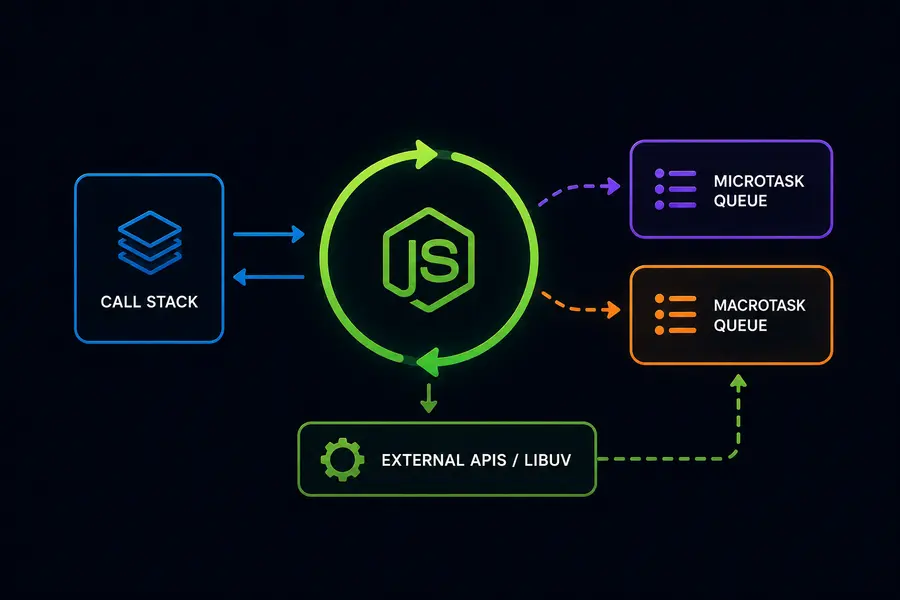
JavaScript itself runs on a single main thread called the Call Stack.
However, Node.js internally uses libuv and background worker threads to handle expensive asynchronous operations.
This architecture allows Node.js to remain non-blocking while handling file systems, networking, and database operations.
How Node.js Handles Async Operations
- JavaScript executes on the Call Stack
- Slow operations are delegated to libuv
- Background workers process the task
- Completed callbacks enter queues
- The Event Loop schedules execution
The main JavaScript thread remains free while asynchronous work happens externally.
The Call Stack
The Call Stack is where synchronous JavaScript executes.
Functions are pushed onto the stack and removed after execution using the LIFO model.
function first() {

    console.log('first');

    second();

    console.log('done');
}

function second() {

    console.log('second');
}

first();
The Event Loop can only process queued tasks when the Call Stack becomes empty.
The Macrotask Queue
Macrotasks contain traditional asynchronous callbacks.
Examples include:
- setTimeout
- setInterval
- setImmediate
- I/O callbacks
setTimeout(() => {

    console.log('timeout');

}, 0);
These callbacks wait in the Macrotask Queue until the Event Loop processes them.
The Microtask Queue
Microtasks have higher priority than macrotasks.
This queue contains:
- Promise.then()
- Promise.catch()
- Promise.finally()
- async/await continuations
- process.nextTick()
Promise.resolve()

    .then(() => {

        console.log('microtask');
    });
The Event Loop always finishes all microtasks before processing the next macrotask.
Event Loop Execution Rules
- Execute synchronous Call Stack code
- Process all microtasks
- Execute one macrotask
- Repeat the cycle
This priority system is critical for understanding asynchronous execution order.
Classic Event Loop Example
console.log('Start');

setTimeout(() => {

    console.log('Timeout');

}, 0);

Promise.resolve()

    .then(() => {

        console.log('Promise');
    });

console.log('End');
The output becomes:
Start
End
Promise
Timeout
Promises execute before timers because microtasks have higher priority.
Why Node.js is Fast
Traditional blocking servers often create one thread per request.
Node.js instead uses asynchronous I/O and event-driven scheduling to maximize concurrency with minimal threads.
This architecture dramatically improves scalability and resource efficiency.
Blocking the Event Loop
Heavy synchronous code can freeze the entire server.
app.get('/block', (req, res) => {

    for (
        let i = 0;
        i < 10000000000;
        i++
    ) {}

    res.send('done');
});
During this loop, the Event Loop cannot process any incoming requests.
All users become blocked until the operation finishes.
Microtask Starvation
Infinite promise recursion can prevent macrotasks from executing.
function infinite() {

    Promise.resolve()

        .then(() => {

            infinite();
        });
}

infinite();
The Event Loop continuously processes microtasks and never reaches macrotasks.
Best Practices
- Avoid heavy synchronous operations
- Use worker threads for CPU-heavy tasks
- Understand microtask priority
- Prefer asynchronous APIs
- Keep the Event Loop responsive
Conclusion
The Event Loop is the core engine that powers Node.js scalability and asynchronous execution.
By understanding the Call Stack, Microtasks, Macrotasks, and libuv architecture, developers can build highly efficient backend applications without blocking the main thread.