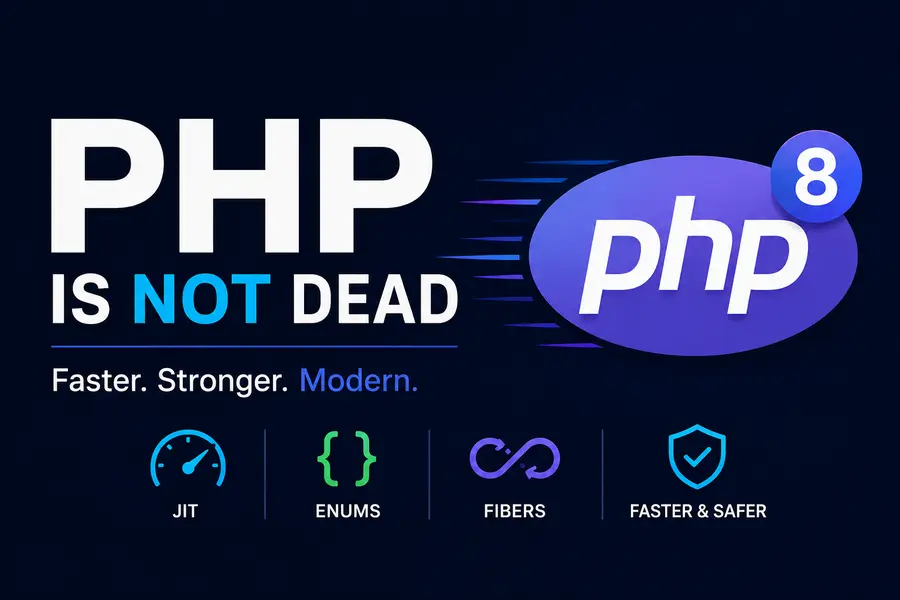
PHP Is Not Dead: How PHP 8 Became Faster and More Modern
For years, developers repeated the phrase “PHP is dead.”
That idea became popular when older PHP versions felt slow, inconsistent, and outdated compared to modern languages like Node.js, Python, and Go.
But PHP in 2025 is very different from the PHP many developers remember.
With PHP 8 and newer versions, the language became faster, cleaner, safer, and much more enjoyable to use.
The PHP 8 Performance Revolution
One of the biggest improvements in PHP 8 is the JIT compiler.
JIT stands for Just-In-Time compilation.
Instead of only interpreting code through the Zend engine, PHP can now compile frequently executed code into machine code.
Why JIT Matters
For normal web requests, the performance improvement may not always be huge because most applications spend time waiting for databases, files, or APIs.
However, for CPU-heavy tasks, JIT can make a major difference.
- Data processing
- Image manipulation
- Mathematical calculations
- Long-running scripts
- Performance-heavy backend tasks
JIT helped PHP become more competitive beyond traditional web page rendering.
Cleaner PHP Syntax
PHP 8 introduced several syntax improvements that make code shorter and easier to read.
Constructor Property Promotion
Older PHP classes required repeated boilerplate code for defining and assigning properties.
class User {
    public string $name;
    public string $email;

    public function __construct(
        string $name,
        string $email
    ) {
        $this->name = $name;
        $this->email = $email;
    }
}
PHP 8 made this much cleaner.
class User {
    public function __construct(
        public string $name,
        public string $email
    ) {}
}
This reduces repetition and makes class definitions easier to maintain.
Named Arguments
Named Arguments make function calls more readable and self-documenting.
Old Style
setcookie(
    "my_cookie",
    "value",
    0,
    "/",
    "example.com",
    true,
    true
);
Modern PHP Style
setcookie(
    name: "my_cookie",
    value: "value",
    secure: true,
    httponly: true
);
The modern version is easier to understand because each value clearly explains its purpose.
Enums in PHP 8.1
Enums introduced stronger type safety into PHP applications.
Before Enums, developers often used strings or constants to represent fixed values like status names.
enum PostStatus: string {
    case Draft = 'draft';
    case Published = 'published';
}
Now PHP can enforce valid values directly through the type system.
class Post {
    public PostStatus $status;
}

$post = new Post();

$post->status = PostStatus::Draft;
This prevents bugs caused by misspelled strings or invalid status values.
The Nullsafe Operator
PHP 8 introduced the Nullsafe Operator, similar to Optional Chaining in JavaScript.
It allows developers to safely access nested objects without writing long null checks.
$street =
    $user?->getProfile()
         ?->getAddress()
         ?->street;
If any value in the chain is null, PHP stops safely instead of throwing an error.
Fibers and Asynchronous PHP
Fibers are one of the most important low-level additions in PHP 8.1.
They allow code execution to be paused and resumed later.
Most developers will not write Fibers directly, but modern frameworks and servers can use them internally to build asynchronous systems.
Why Fibers Matter
Traditional PHP applications often run in a blocking request-response model.
When a request waits for an external API or database response, that worker cannot process other tasks.
Fibers make it possible for frameworks and tools to build more efficient event-driven systems.
This is especially useful with tools like Laravel Octane, Swoole, and RoadRunner.
Modern PHP and Laravel
Laravel played a major role in keeping PHP popular and productive.
With modern PHP features, Laravel applications are cleaner, faster, and easier to scale.
Features like typed properties, Enums, constructor promotion, and improved performance make modern Laravel development much better than older PHP development.
Why PHP Is Still Relevant
- Huge ecosystem
- Strong Laravel and Symfony communities
- Excellent hosting support
- Modern language features
- Improved performance
- Massive WordPress usage
- Better type safety
PHP vs Modern Backend Languages
PHP no longer feels like an outdated scripting language.
Modern PHP can compete seriously with Node.js, Python, and other backend technologies for many web application use cases.
It may not be the best tool for every problem, but it remains one of the most practical and productive backend languages available.
Best Modern PHP Features
- JIT Compiler
- Enums
- Fibers
- Named Arguments
- Constructor Property Promotion
- Nullsafe Operator
- Union Types
- Readonly Properties
Conclusion
PHP is not dead.
It has evolved into a modern, powerful, and high-performance backend language.
PHP 8 introduced major improvements in performance, syntax, type safety, and asynchronous architecture.
For developers who left PHP years ago, returning to modern PHP feels like working with a completely different language.
With Laravel, Symfony, PHP 8, and modern deployment tools, PHP remains a strong choice for building scalable web applications in 2025.